
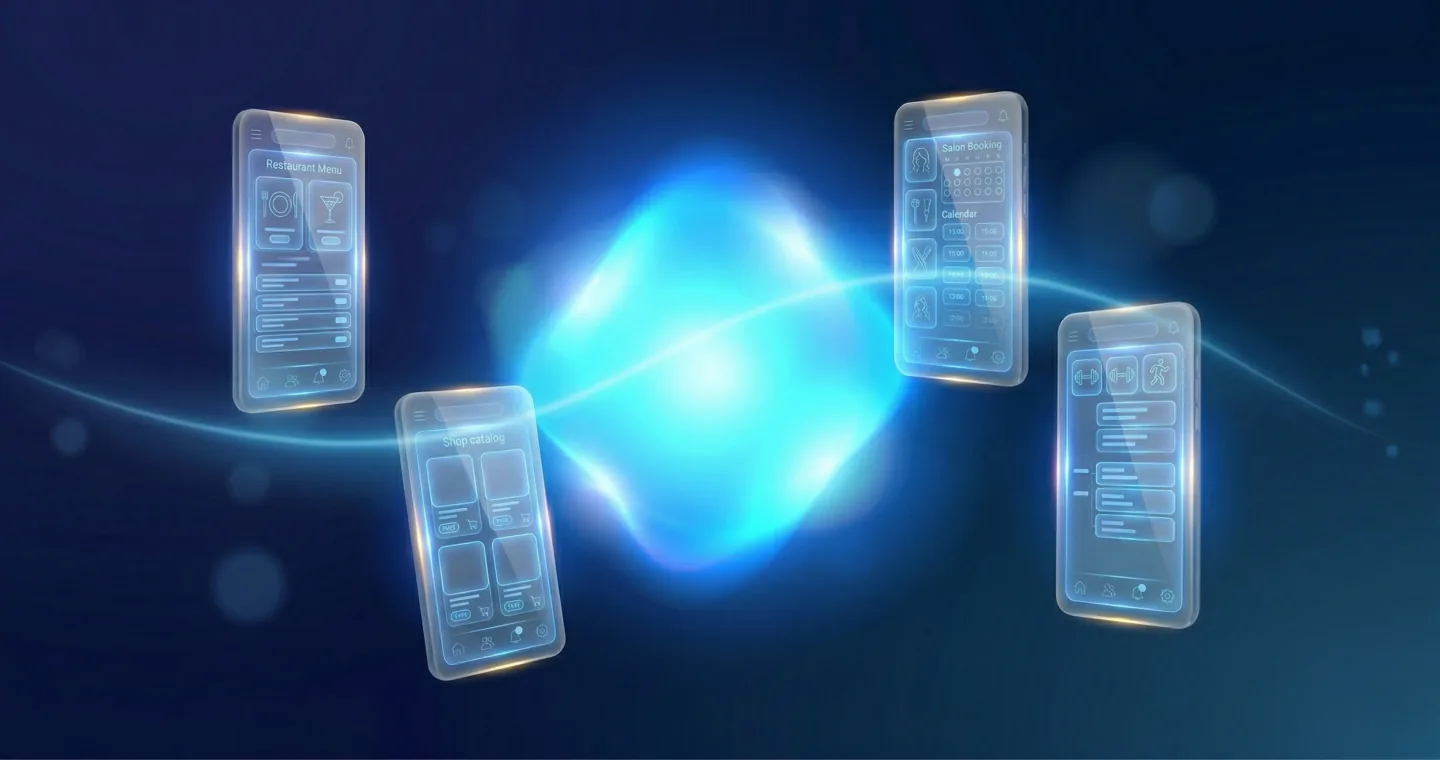
For years, small businesses have faced a frustrating paradox. Having a mobile app would help them reach customers, accept payments, build loyalty, and send notifications. But building one cost $50,000 to $150,000, took months, and required convincing customers to actually download it. Most small businesses simply could not justify the investment, and most customers would not install the app even if they could.
Mini apps have eliminated every barrier in that equation. They cost a fraction of traditional development. They are live in hours, not months. And customers access them through a link with no download required. A QR code on a restaurant table, a link in an Instagram bio, a WhatsApp message to existing customers - each one opens a full app experience instantly.
The shift is not theoretical. Apple launched the Mini Apps Partner Program in November 2025. Telegram Mini Apps serve over 950 million users. The global super-app market is projected to reach nearly $1 trillion by 2033. Mini apps are becoming the standard way small businesses operate on mobile.
This article covers the specific ways mini apps are changing small business in 2026, industry by industry, with the economics behind why it matters.
The old model was broken
The traditional path to mobile for a small business looked like this: hire a development team, spend $50,000-$150,000, wait 6-12 months for the build, submit to the App Store, wait days to weeks for review, then figure out how to convince your customers to search for your app, download it, install it, create an account, and hopefully use it.
The numbers tell the story of why this model failed for most small businesses. The average person downloads fewer than 10 new apps per month. Over half of all downloaded apps are deleted within the first 30 days. The cost of acquiring a single app download through advertising runs $2-$15 per user. For a neighborhood restaurant, salon, or gym, paying thousands of dollars in marketing to get customers to download an app they might delete next week is not a viable business strategy.
The result: the businesses that would benefit most from mobile, small local businesses with repeat customers, were the least able to afford it or make it work.
What changed
Three developments converged to create the mini app opportunity for small business.
The technology matured. Web technologies evolved to the point where a link-based experience can deliver push notifications, Apple Pay, home screen presence, full-screen presentation, and offline caching. The gap between a mini app and a native app narrowed to the point where most customers cannot tell the difference for typical business interactions.
AI made creation instant. Platforms like Easyapp use AI to generate a complete, working mini app from a business description in about 1 minute. The skill, time, and money previously required to create an app dropped to near zero. A restaurant owner can have a live mini app with a digital menu, loyalty program, push notifications, and Apple Pay checkout before the lunch rush.
Apple validated the model. When Apple launched the Mini Apps Partner Program with a 15% commission rate (its most favorable terms ever), it sent an unmistakable signal: lightweight, link-based apps are a permanent part of the mobile future. This institutional backing accelerated adoption across the entire ecosystem.
How mini apps are changing specific industries
The impact is easiest to understand through concrete examples. Here is what the shift looks like across the industries where mini apps have the most immediate effect.
Restaurants and cafes
Before mini apps: Paper menus. Phone orders. Third-party delivery platforms taking 15-30% of every order. No direct relationship with customers. No way to send a notification about tonight's special. Loyalty cards that get lost in wallets.
With mini apps: A QR code on every table opens a digital menu with photos, descriptions, and prices. Customers order and pay with Apple Pay. A digital loyalty program rewards regulars with points they scan at each visit. Push notifications announce daily specials, happy hour deals, and new menu items directly to customers' phones. The restaurant owns the customer relationship and keeps its margins.
The economics: If a restaurant does 100 delivery orders per week at $35 average order value through a platform charging 25% commission, that is $45,500 per year in commissions. Even partial migration to a direct mini app ordering channel saves tens of thousands annually.
Hair salons and beauty studios
Before mini apps: Bookings managed through phone calls, Instagram DMs, and WhatsApp messages across multiple channels. No-shows with no automated reminders. Paper loyalty cards. No way to notify clients about cancellation openings.
With mini apps: Clients tap a link from WhatsApp or Instagram and book an appointment in seconds with real-time availability. Push notifications send automatic reminders before each visit. A QR-based loyalty program rewards repeat visits with points redeemable for services. When someone cancels, a push notification fills the empty slot within minutes.
The economics: Research indicates that businesses offering online booking capture significantly more appointments than those relying on phone calls alone. Automated reminders reduce no-shows. Loyalty programs increase visit frequency. Each of these individually improves revenue; together, they transform the business model.
Fitness studios and gyms
Before mini apps: Class schedules posted on a wall or website. Bookings through phone or email. Membership management through separate software costing $50-$500 per month. No direct communication channel with members outside of email.
With mini apps: Members access class schedules, book sessions, and manage their membership through a link on the gym's website or a QR code poster in the lobby. Push notifications announce schedule changes, new classes, and promotions. A loyalty program rewards consistent attendance. New members engage immediately with no download barrier.
The economics: Dedicated gym management software like Mindbody or Glofox can cost $100-$500+ per month and requires staff training. A mini app covers the core member-facing features, booking, schedules, notifications, loyalty, at a fraction of the cost, while the gym-facing management stays in whatever system the owner already uses.
Retail and e-commerce
Before mini apps: A website that looks mediocre on mobile. An Instagram shop with limited functionality. Maybe a Shopify store. No push notifications. No loyalty program integrated with the shopping experience. Every customer interaction depends on them returning to the website or social media on their own.
With mini apps: A product catalog with categories, images, descriptions, and prices. Apple Pay and Stripe for seamless checkout. Push notifications for new arrivals, flash sales, and restocked items. A loyalty program that rewards purchases. Distribution through QR codes on packaging, tags in physical stores, links in email campaigns, and social media bios.
The economics: Push notifications alone are a revenue driver that small e-commerce businesses typically cannot access without a native app. A well-timed notification about a restocked popular item or a flash sale can generate immediate revenue from an audience the business already has.
Content creators and personal brands
Before mini apps: A Linktree page with a list of links. Content scattered across Instagram, YouTube, TikTok, and a website. No direct communication channel with followers. Monetization dependent entirely on platform algorithms and ad revenue. No membership or subscription offering.
With mini apps: All links, content, events, membership programs, and products in a single app experience. Followers tap one link in a bio and get something far richer than any link-in-bio page. Push notifications reach the audience directly, independent of algorithm changes. Membership tiers offer premium content access for paying subscribers. Events and products sell through the same app with Apple Pay checkout.
The economics: Creators who depend on platform algorithms for reach are building on rented land. A mini app creates an owned audience channel. Push notifications reach followers regardless of whether Instagram decides to show the next post. Membership revenue is recurring and predictable. This combination, owned audience plus direct monetization, is the business model shift that serious creators are making.
Event organizers
Before mini apps: Event information on a website or Facebook event page. Registration through Eventbrite or Google Forms. No push notifications for reminders or updates. Check-in through paper lists or separate apps that attendees have to download.
With mini apps: A complete event experience through a single link. Registration, schedule, speaker information, venue map, push notification reminders, and check-in, all in one app that attendees access by tapping a link. No pre-event download instructions. Updates go live instantly if the schedule changes.
The economics: Every email asking attendees to "download our event app before you arrive" loses a significant percentage of the audience. A mini app link has zero friction. Every attendee who receives the link can access the event app, which means higher engagement, better communication, and smoother operations.
Five shifts that matter
Across all industries, mini apps are driving five fundamental changes in how small businesses operate.
From download to link. The business-customer connection no longer depends on convincing someone to install an app. Every QR code, every social media bio link, every WhatsApp message becomes an instant app entry point. Distribution becomes as simple as sharing a URL.
From expensive to accessible. The cost of having a professional mobile presence dropped from $50,000-$150,000 to a simple subscription. AI handles creation in minutes. Hosting, maintenance, and updates are included. The small business owner who could never afford an app can now have one running by tomorrow.
From silent to connected. Push notifications give small businesses a direct communication channel with customers. This was previously only available to businesses with native apps and the budgets to build and maintain them. A salon can now remind clients before appointments, a restaurant can announce today's special, and a gym can notify members about a new class, all reaching customers' phones directly.
From anonymous to loyal. QR-based loyalty programs turn one-time visitors into tracked, rewarded repeat customers. The coffee shop knows how often a customer visits and can reward their tenth purchase automatically. The salon knows when a client is due for their next appointment. These relationships were previously invisible without expensive POS or CRM systems.
From static to instant. Menus, prices, products, schedules, and promotions update instantly. No App Store review. No waiting for a developer. The business owner makes a change in the editor, and every customer sees it immediately. A restaurant can add a daily special at 10am and have customers seeing it by lunch.
The Apple validation
Apple's launch of the Mini Apps Partner Program in November 2025 matters for small businesses not because they need to join the program (it is designed for platform developers, not individual businesses), but because of what it signals.
When Apple builds formal infrastructure for mini apps with its most favorable revenue terms ever (85% to developers, 15% to Apple), it means the mini app model is not experimental. It is not a workaround. It is a permanent part of how mobile works going forward. The tools, platforms, and user expectations around mini apps will continue improving because the industry's most influential company is investing in them.
For a small business owner, this translates to confidence. The mini app you create today will become more capable over time, not less. The format will become more familiar to your customers, not less. The ecosystem will grow, not shrink.
Related Reading
- 10 Things You Can Build With a Mini App Maker — Real use cases across 10 industries
- How Much Does It Cost to Build an App in 2026? — Full cost breakdown for small businesses
- Mini App vs Native App: Which Is Right? — Why small businesses choose mini apps over App Store publishing
How to get started
The process is designed for business owners, not developers. AI mini app maker for everyone - that is the idea behind Easyapp.
- Download Easyapp from the App Store or Google Play
- Describe your business or paste your website URL
- AI creates your complete mini app in about 1 minute
- Customize with the drag-and-drop editor
- Publish and share your link
Not vibe coding, real Mini Apps. Your mini app is live within 1-2 hours. Push notifications, loyalty programs, appointment booking, payments, forms, events, membership management, and more. All digital services, one app.
Start with your core need: a digital menu, online booking, or a product catalog. Share the link with existing customers. Add services as your needs grow. The modular approach means you do not need to launch with everything on day one.
Frequently Asked Questions
Do small businesses really need an app?
The question is no longer whether you need an app. It is whether you can afford to make customers download one. Over half of all downloaded apps get deleted within 30 days. A mini app gives you everything an app provides, push notifications, payments, loyalty, booking, without the download barrier that stops most customers from ever using it.
How much does a mini app cost for a small business?
A mini app maker like Easyapp costs over 99% less than custom app development. Traditional development runs $50,000-$150,000+. A mini app subscription includes hosting, maintenance, updates, and cross-platform support. Visit easyapp.ai for current pricing.
Can a mini app replace my website?
For many small businesses, yes. A mini app offers everything a mobile website does, plus push notifications, Apple Pay, home screen presence, loyalty programs, and a native app feel. It is accessible through a link just like a website, but the customer experience is significantly better.
How quickly can I get a mini app for my business?
With Easyapp, AI creates a complete mini app in about 1 minute from a description of your business. You can customize and publish within hours. Your mini app is typically live within 1-2 hours after publishing.
What industries benefit most from mini apps?
Any business where customers interact frequently and benefit from zero-friction access. Restaurants, cafes, hair salons, fitness studios, retail shops, content creators, event organizers, real estate agents, and professional service providers all see significant benefits from the mini app model.
Keep reading
- What Is a Mini App? The Complete Guide for 2026 - Everything you need to know about what mini apps are and how they work
- How to Create a Mobile App Without Coding in 2026 - Four ways to build an app, compared on cost and speed
- How to Create a Restaurant App in 1 Minute - See the mini app model in action for a specific industry
- The History of Mini Apps: From WeChat to Apple - How mini apps went from China to a global movement
Ready to bring your business into the mini app era? Visit easyapp.ai to learn more, or download Easyapp from the App Store or Google Play and build your app in 1 minute.